



Boquillas de acero inoxidable vs cerámicas: ¿Qué material es más resistente al desgaste en entornos de alta presión?
Al operar sistemas de pulverización a alta presión, cortadores de chorro de agua o equipos de limpieza industriales, elegir el material adecuado para la boquilla puede marcar la diferencia entre reemplazos frecuentes y años de servicio fiable. Esta guía completa examina la resistencia al desgaste de las boquillas de acero inoxidable y cerámica en aplicaciones exigentes de alta presión.
- 1. 1. Comprendiendo el desgaste de las toberas en sistemas de alta presión
- 1.1. ¿Qué causa el desgaste de la boquilla?
- 1.2. Por qué importa la selección de materiales
- 2. 2. Boquillas de acero inoxidable: Propiedades y rendimiento
- 2.1. Características materiales
- 2.2. Rendimiento en aplicaciones de alta presión
- 2.3. Ventajas del acero inoxidable
- 2.4. Limitaciones y debilidades
- 3. 3. Boquillas cerámicas: tecnología avanzada de materiales
- 3.1. Tipos de materiales cerámicos
- 3.2. Características de rendimiento
- 3.3. Ventajas de los materiales cerámicos
- 3.4. Limitaciones y consideraciones
- 4. 4. Comparación directa: Pruebas de resistencia al desgaste
- 4.1. Pruebas de chorro de agua abrasivo
- 4.2. Aplicaciones de pulverización a alta presión
- 4.3. Correlación entre dureza y tasa de desgaste
- 4.4. Pruebas de impacto y choque térmico
- 5. 5. Recomendaciones específicas para la aplicación
- 5.1. Sistemas de corte por chorro de agua
- 5.2. Limpieza por Spray Industrial
- 5.3. Procesamiento y recubrimiento químico
- 5.4. Agricultura e Riego
- 5.5. Automoción y Fabricación
- 6. 6. Análisis de costes y consideraciones sobre el ROI
- 6.1. Comparación inicial de inversiones
- 6.2. Vida útil y frecuencia de reemplazo
- 6.3. Coste total de propiedad
- 6.4. Análisis de Punto de Equilibrio
- 7. 7. Mantenimiento y optimización de la vida útil
- 7.1. Mejores prácticas de instalación
- 7.2. Optimización de parámetros de funcionamiento
- 7.3. Criterios de inspección y sustitución
- 7.4. Almacenamiento y manipulación
- 8. 8. Tendencias futuras en materiales de boquillas
- 8.1. Composiciones Cerámicas Avanzadas
- 8.2. Boquillas recubiertas de diamante
- 8.3. Fabricación aditiva
- 8.4. Tecnología de Boquillas Inteligentes
- 8.5. Materiales sostenibles
- 9. Conclusión: Tomando la decisión correcta
1. Comprendiendo el desgaste de las toberas en sistemas de alta presión
El desgaste de las toberas es una preocupación crítica en aplicaciones a alta presión donde los fluidos —a menudo con partículas abrasivas— pasan por pequeños orificios a velocidades extremas. El mecanismo de desgaste implica múltiples factores que degradan gradualmente el rendimiento de la tobera.
¿Qué causa el desgaste de la boquilla?
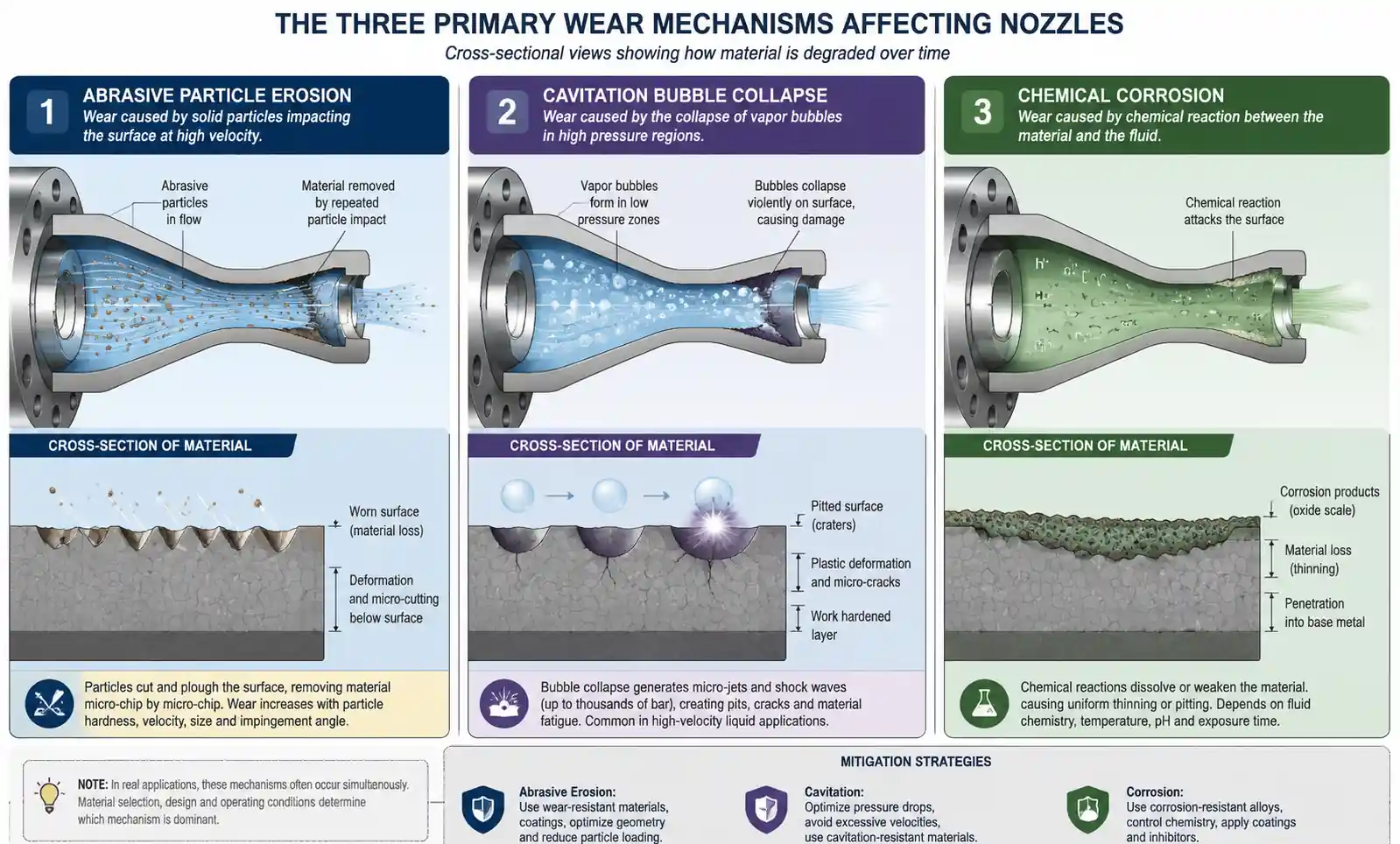
Tres mecanismos principales contribuyen a la degradación de la tobera:
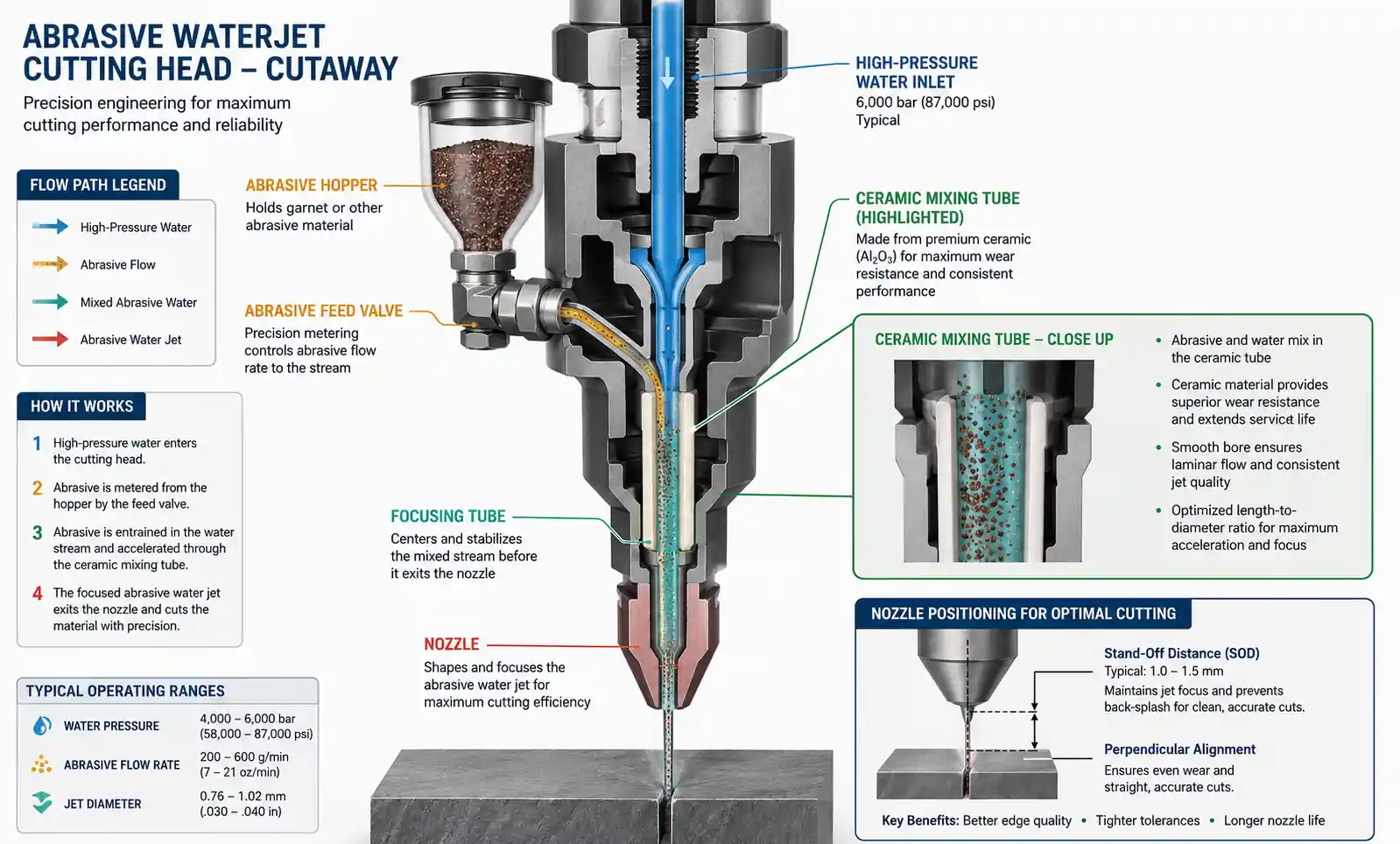
La erosión abrasiva ocurre cuando partículas sólidas suspendidas en el fluido impactan contra las paredes de la boquilla. En los sistemas de corte por chorro de agua, por ejemplo, materiales abrasivos como el granate viajan a velocidades superiores a 900 metros por segundo, creando un desgaste localizado intenso.
Daño por cavitación ocurre cuando las caídas de presión provocan la formación de burbujas de vapor que colapsan violentamente contra las superficies de las toberas. Estas implosiones generan ondas de choque que pueden perforar y erosionar incluso materiales endurecidos.
La corrosión química afecta a las boquillas expuestas a fluidos agresivos o a ambientes de alta temperatura. Aunque es menos dramático que el desgaste mecánico, el ataque químico puede debilitar la estructura del material y acelerar la falla.
! diagrama de mecanismos de desgaste de tobera
Por qué importa la selección de materiales
El orificio de la boquilla sufre las condiciones más severas en cualquier sistema de pulverización. A medida que el fluido acelera a través de esta restricción, las velocidades pueden alcanzar velocidades supersónicas mientras que las presiones pueden superar los 60.000 PSI en aplicaciones industriales de chorro de agua.
La dureza del material, la tenacidad y la estabilidad química influyen en cuánto tiempo mantiene una boquilla su geometría original. Incluso un pequeño agrandamiento del orificio puede reducir significativamente la eficiencia del corte o la precisión del patrón de pulverización.
2. Boquillas de acero inoxidable: Propiedades y rendimiento
El acero inoxidable ha sido la opción tradicional para toberas industriales debido a su combinación de resistencia mecánica, resistencia a la corrosión y mecanizabilidad. Sin embargo, no todas las calidades de acero inoxidable rinden igual en entornos de alta presión.
Características materiales
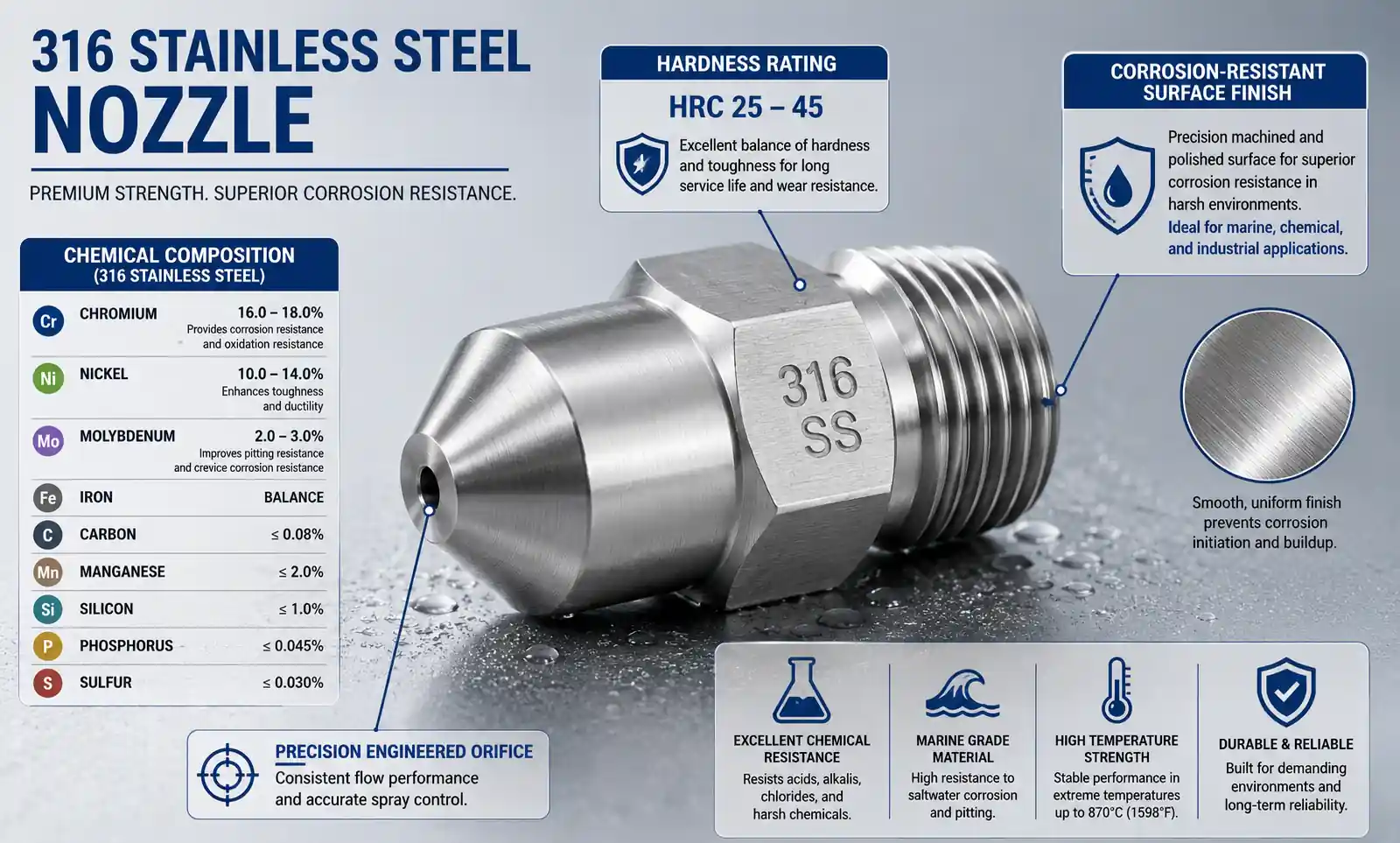
El acero inoxidable 316 es la categoría más común para la fabricación de toberas. Ofrece una excelente resistencia a la corrosión gracias a su composición de cromo-níquel-molibdeno y mantiene la integridad estructural en un amplio rango de temperaturas.
La dureza Rockwell del material suele oscilar entre HRC 25-35 en condición de recocido, aunque el tratamiento térmico puede aumentar esta cifra hasta HRC 40-45. Esta dureza moderada proporciona una buena resistencia al desgaste manteniendo la ductilidad que previene fallos catastróficos y frágiles.
! propiedades de boquilla de acero inoxidable
Rendimiento en aplicaciones de alta presión
Las boquillas de acero inoxidable destacan en aplicaciones que implican fluidos limpios o ligeramente abrasivos. En sistemas de lavado a alta presión que operan a 3.000-10.000 PSI con medios solo de agua, las boquillas de acero inoxidable de calidad pueden ofrecer entre 500 y 1.000 horas de servicio antes de necesitar ser reemplazadas.
Sin embargo, cuando entran en juego partículas abrasivas, el rendimiento se degrada rápidamente. Los sistemas de corte por chorro de agua que utilizan medios abrasivos suelen ver que los tubos de mezcla de acero inoxidable fallan tras solo 1-2 horas de funcionamiento. El material relativamente blando no puede soportar las intensas fuerzas erosivas.
Ventajas del acero inoxidable
La rentabilidad hace que el acero inoxidable sea atractivo para operaciones con presupuesto limitado. Las boquillas suelen costar entre 15 y 50 dólares dependiendo del tamaño y la complejidad, significativamente menos que las alternativas cerámicas.
La mecanizabilidad permite geometrías complejas y diseños personalizados. Los fabricantes pueden producir configuraciones especializadas de toberas que serían difíciles o imposibles con materiales cerámicos.
La ductilidad previene fallos catastróficos repentinos. Las toberas de acero inoxidable suelen desgastarse gradualmente, proporcionando señales visuales de advertencia antes de que ocurra un fallo total.
Limitaciones y debilidades
El desgaste rápido en ambientes abrasivos es la principal limitación. Cuando se exponen a partículas duras como arena, granate o óxidos metálicos, los orificios de acero inoxidable se agrandan rápidamente, reduciendo la calidad de la pulverización y la eficiencia del sistema.
Las limitaciones de presión se hacen evidentes por encima de 40.000 PSI. La resistencia al límite elástico del material puede ser insuficiente para aplicaciones a ultra alta presión sin un grosor excesivo de la pared.
3. Boquillas cerámicas: tecnología avanzada de materiales
Las boquillas cerámicas representan un avance tecnológico significativo en componentes resistentes al desgaste. Estos materiales diseñados ofrecen niveles de dureza que superan con creces las alternativas metálicas, aunque tienen sus propias desventajas.
Tipos de materiales cerámicos
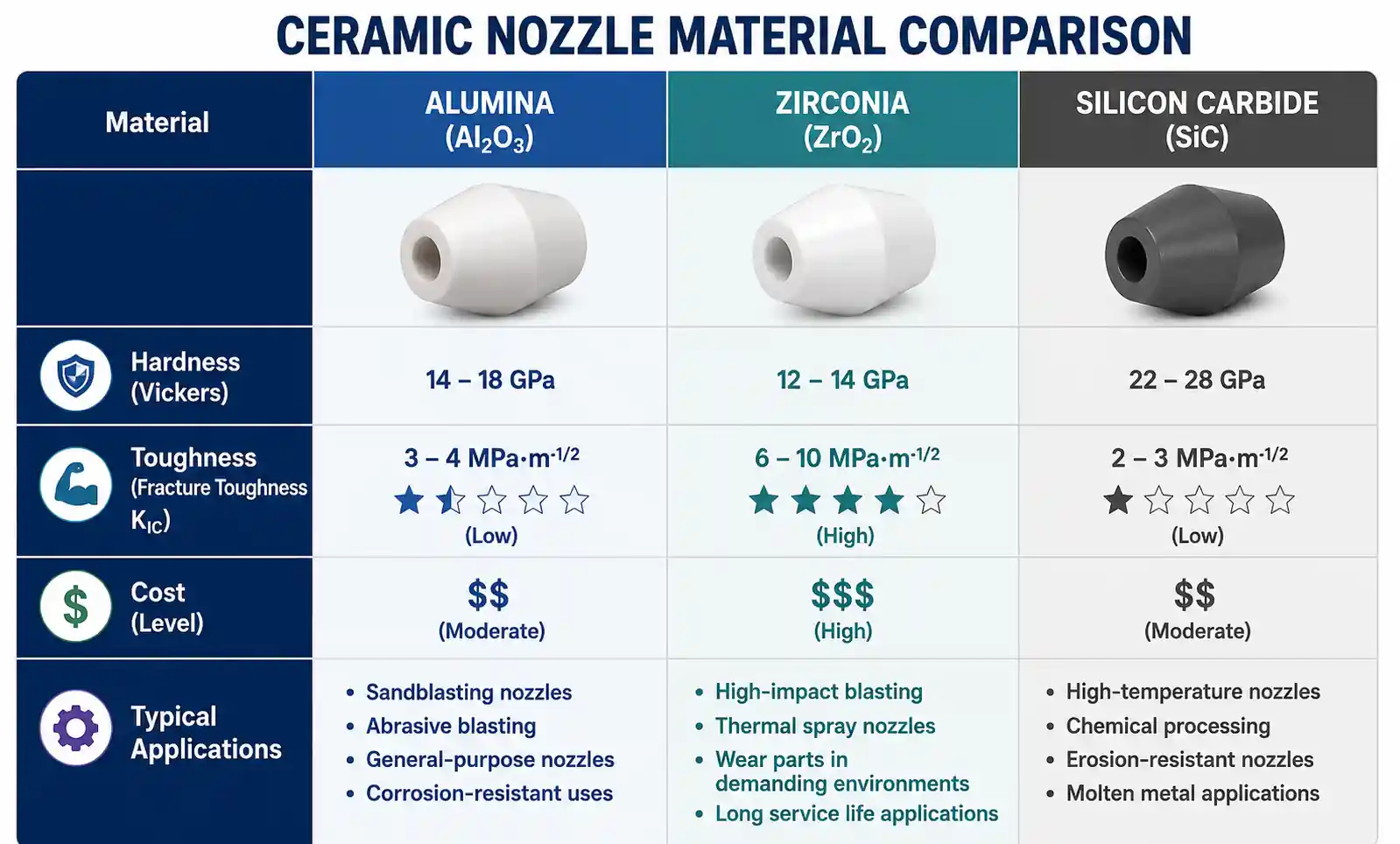
La alúmina (Al₂O₃) es la opción cerámica más económica. Con durezas de 1.500-1.800 de alta temperatura, las toberas de alúmina resisten el desgaste abrasivo mucho mejor que el acero inoxidable. Se usan comúnmente en arenado y aplicaciones abrasivas de chorro de agua.
La circonia (ZrO₂) ofrece una resistencia superior en comparación con la alúmina. Aunque es algo menos duro a HV 1.200-1.400, la tenacidad a la fractura de la circonia la hace más resistente a daños por impacto y choques térmicos.
El carburo de silicio (SiC) representa el nivel premium de materiales cerámicos para toberas. Con una dureza cercana a HV 2.500 y una excelente conductividad térmica, las toberas de carburo de silicio ofrecen la máxima resistencia al desgaste en las aplicaciones más exigentes.
! comparación de materiales de boquilla cerámica
Características de rendimiento
Las boquillas cerámicas mantienen su geometría de orificio mucho más tiempo que las alternativas metálicas en ambientes abrasivos. En aplicaciones de corte por chorro de agua, las boquillas cerámicas de calidad pueden funcionar entre 100 y 200 horas con medios abrasivos, una mejora de 50 a 100 veces respecto al acero inoxidable.
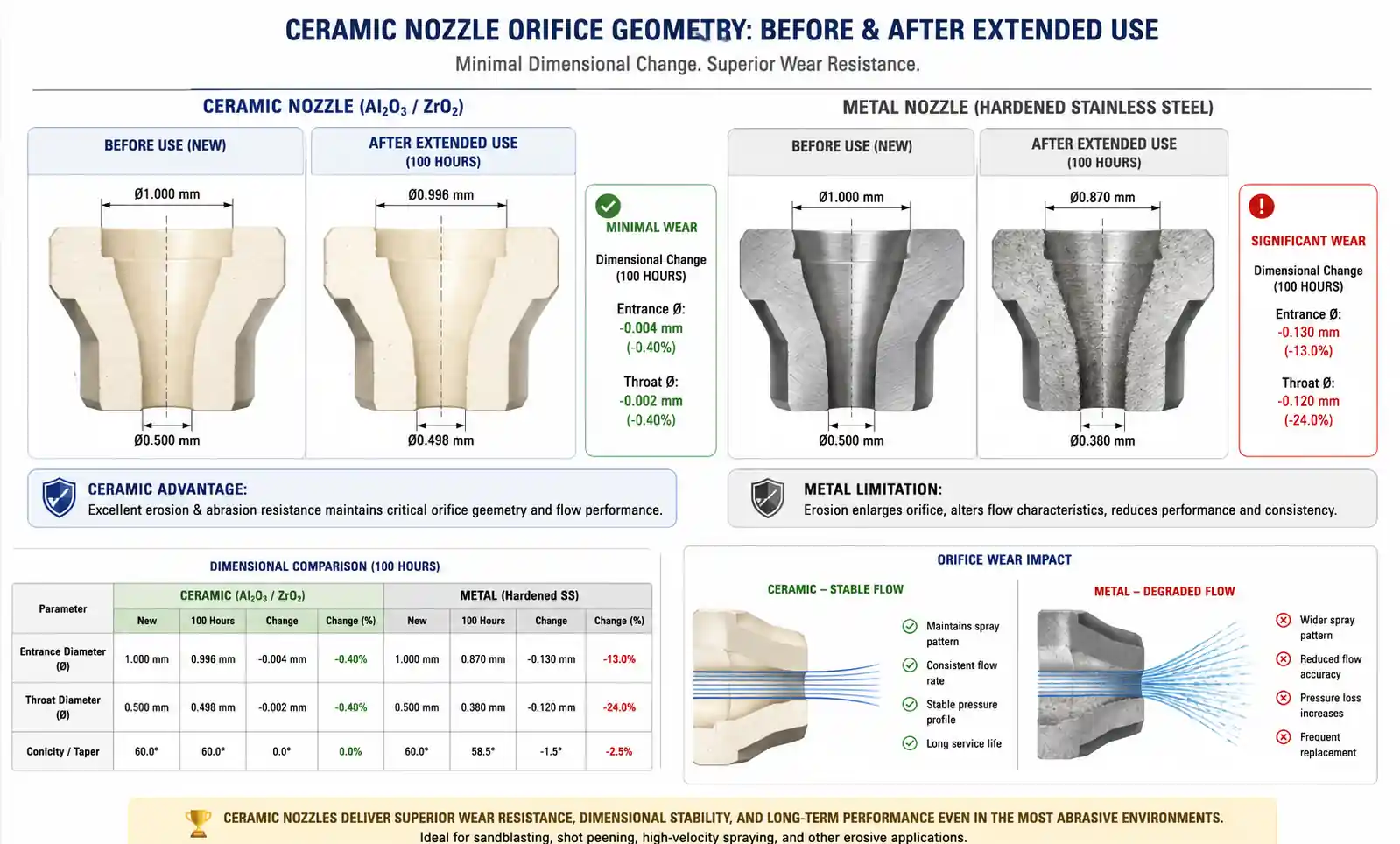
La extrema dureza de los materiales cerámicos hace que las partículas abrasivas causen una erosión mínima. Incluso tras un uso prolongado, las boquillas cerámicas suelen mantener las dimensiones del orificio dentro de unos pocos micrómetros respecto a las especificaciones originales.
Ventajas de los materiales cerámicos
Resistencia al desgaste excepcional es la característica definitoria. Los valores de dureza cerámica de 1.200-2.500 HV enanos superan a los de acero inoxidable entre 150 y 250 HV, lo que se traduce directamente en una vida útil extendida en aplicaciones abrasivas.
La inercia química hace que la cerámica sea ideal para ambientes corrosivos. A diferencia de los metales, las cerámicas no se oxidan ni corroen cuando están expuestas a ácidos, bases o fluidos de alta temperatura.
La estabilidad dimensional bajo presión y temperatura garantiza patrones de pulverización consistentes durante toda la vida útil de la boquilla. Las cerámicas presentan una expansión térmica mínima y no se deforman bajo cargas de alta presión.
! cerámica-tobera-estabilidad-dimensional
Limitaciones y consideraciones
La fragilidad es la principal preocupación con las boquillas cerámicas. Aunque extremadamente dura, las cerámicas carecen de ductilidad y pueden fracturarse repentinamente si se someten a impactos, choques térmicos o una instalación incorrecta.
Un coste inicial más alto puede ser un obstáculo para la adopción. Las boquillas cerámicas suelen costar entre 100 y 500 dólares dependiendo de la calidad y tamaño del material—5-10 veces más que unidades de acero inoxidable comparables.
Las limitaciones de fabricación limitan la flexibilidad del diseño. Geometrías complejas que son sencillas con metal mecanizado se vuelven complicadas o imposibles con cerámicas sinterizadas.
4. Comparación directa: Pruebas de resistencia al desgaste
Las pruebas en el mundo real ofrecen la imagen más clara de cómo funcionan estos materiales en condiciones idénticas. Múltiples estudios han cuantificado las diferencias de resistencia al desgaste entre las toberas de acero inoxidable y cerámicas.
Pruebas de chorro de agua abrasivo
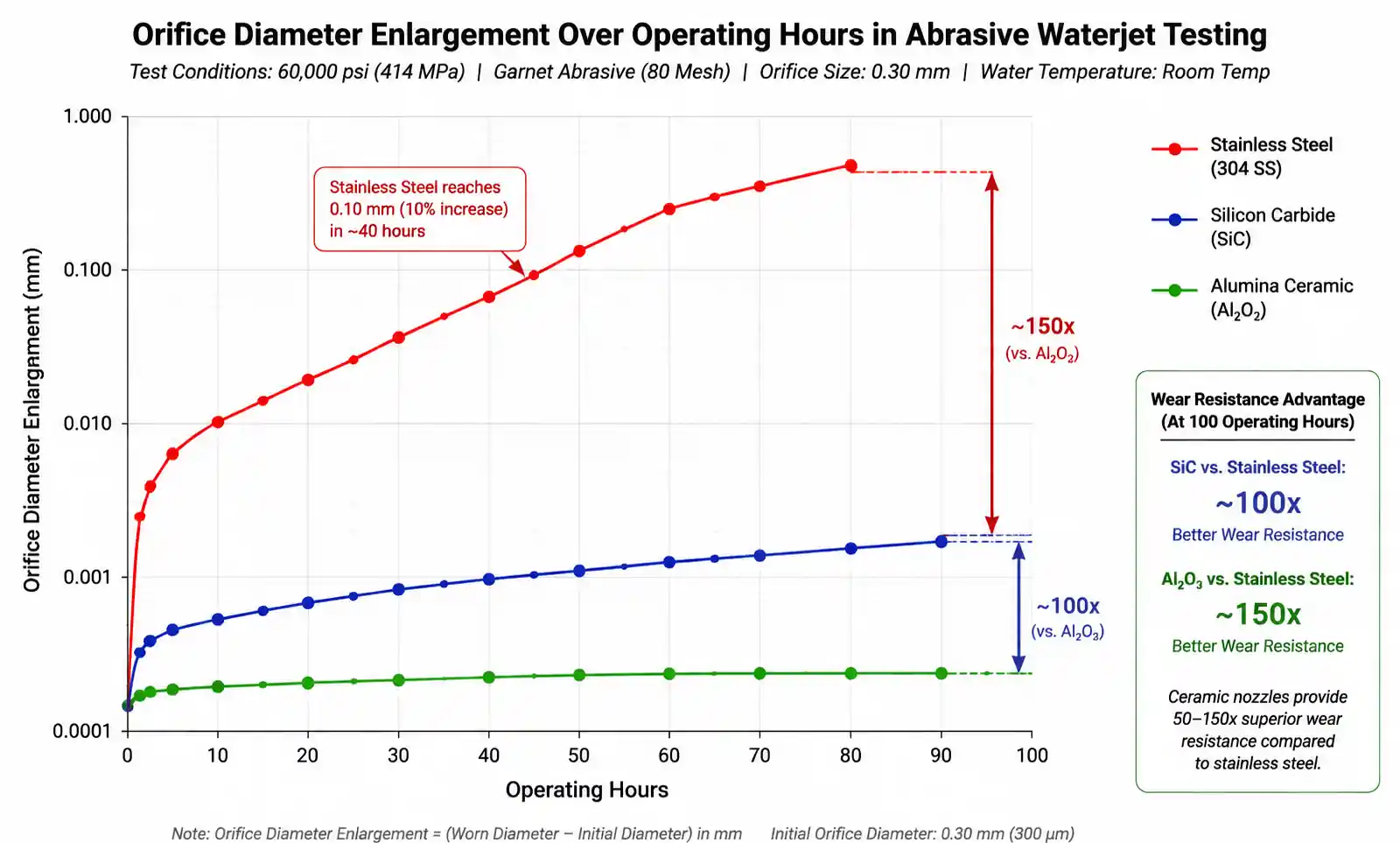
En pruebas de corte controlado por chorro de agua utilizando abrasivo granate de 80 mallas a 50.000 PSI, los investigadores midieron el agrandamiento del orificio a lo largo del tiempo:
Los tubos mezcladores de acero inoxidable mostraron un aumento de 0,010" de diámetro tras solo 1 hora de funcionamiento. En 2 horas, el agrandamiento del orificio superó los 0,020", haciendo que la boquilla fuera ineficaz para cortes de precisión.
Boquillas cerámicas de alúmina demostraron un agrandamiento de 0,010" tras 80 horas de funcionamiento idéntico, una mejora de 80 veces en la resistencia al desgaste.
Las boquillas de carburo de silicio mantuvieron las dimensiones del orificio dentro de 0,005" tras 150 horas, lo que representa una mejora de 150 veces respecto al acero inoxidable.
! gráfico-resultados-resistencia-desgaste-prueba-gráfico
Aplicaciones de pulverización a alta presión
Las pruebas en sistemas de limpieza industrial que operan a 10.000 PSI con agua conteniendo sólidos en suspensión revelaron:
Las toberas de acero inoxidable perdieron un 15% de su capacidad de flujo tras 200 horas debido al agrandamiento del orificio. La degradación del patrón de pulverización se hizo notable tras 150 horas.
Las toberas cerámicas de alúmina mantuvieron el 98% de la capacidad de flujo original tras 1.000 horas. Los patrones de pulverización se mantuvieron consistentes durante todo el periodo de prueba.
Correlación entre dureza y tasa de desgaste
La dureza del material se correlaciona directamente con la resistencia al desgaste en ambientes abrasivos. La relación es la siguiente:
- Acero inoxidable (HV 150-250): Tasa de desgaste base
- Cerámica alúmina (HV 1.500-1.800): 50-100 veces mejor resistencia al desgaste
- Carburo de silicio (HV 2.400-2.800): 100-200 veces mejor resistencia al desgaste
Esta diferencia tan notable explica por qué las boquillas cerámicas predominan en aplicaciones abrasivas a pesar de su mayor coste inicial.
Pruebas de impacto y choque térmico
La fragilidad de la cerámica se hace evidente en las pruebas de impacto. Dejar caer boquillas cerámicas desde alturas de tan solo 3 pies sobre el hormigón puede causar fracturas, mientras que las unidades de acero inoxidable sobreviven a estos impactos sin daños.
Las pruebas de choque térmico revelan patrones similares. Los cambios rápidos de temperatura que superan los 200°F pueden agrietar las boquillas cerámicas, especialmente la alúmina. El acero inoxidable soporta el ciclo térmico sin daños estructurales.
5. Recomendaciones específicas para la aplicación
La elección entre boquillas de acero inoxidable y cerámica depende de tus condiciones de funcionamiento específicas. Aquí tienes orientación para aplicaciones más comunes:
Sistemas de corte por chorro de agua
Para el corte por chorro de agua abrasivo, las boquillas cerámicas son esenciales. La intensa erosión causada por granate u otros medios abrasivos hace que el acero inoxidable sea económicamente inviable. Los tubos de mezcla de carburo de silicio ofrecen el mejor rendimiento, mientras que la alúmina ofrece una alternativa rentable para trabajos menos exigentes.
Para corte puro por chorro de agua (sin abrasivos), los orificios de acero inoxidable funcionan adecuadamente a presiones inferiores a 60.000 PSI. Sin embargo, los orificios cerámicos siguen ofreciendo una vida útil 5-10 veces mayor y mantienen mejor la precisión del corte con el tiempo.
! guía de aplicación de tobera por chorro de agua
Limpieza por Spray Industrial
Lavado a alta presión (3.000-10.000 PSI) con agua limpia se adapta bien a las boquillas de acero inoxidable. El ahorro justifica un reemplazo más frecuente cuando el contenido abrasivo es mínimo.
La limpieza abrasiva con chorros o aplicaciones que involucren sólidos en suspensión requieren boquillas cerámicas. La vida útil extendida compensa rápidamente la mayor inversión inicial.
Procesamiento y recubrimiento químico
La pulverización de productos químicos corrosivos se beneficia de la inercia química de la cerámica. El acero inoxidable puede corroerse en ambientes químicos agresivos, mientras que las cerámicas permanecen intactas.
Las aplicaciones a altas temperaturas por encima de 500°F favorecen la cerámica por su estabilidad térmica. El acero inoxidable puede oxidarse y perder resistencia a temperaturas elevadas.
Agricultura e Riego
Boquillas estándar de riego que usan agua filtrada funcionan bien con acero inoxidable. El entorno operativo limpio no justifica el coste premium de la cerámica.
La pulverización de fertilizantes o pesticidas con soluciones cargadas de abrasivo puede beneficiarse de las boquillas cerámicas en operaciones comerciales de alto uso.
Automoción y Fabricación
La pintura en spray suele usar acero inoxidable debido al fluido limpio y las presiones moderadas que implica. La capacidad de mecanizar patrones complejos de pulverización supera las preocupaciones de resistencia al desgaste.
El desbarbado abrasivo o preparación superficial requiere boquillas cerámicas para soportar las duras condiciones de funcionamiento.
6. Análisis de costes y consideraciones sobre el ROI
Aunque las boquillas cerámicas cuestan significativamente más al principio, el coste total de propiedad suele favorecer a la cerámica en aplicaciones abrasivas. Examinemos la economía:
Comparación inicial de inversiones
Boquillas de acero inoxidable: 15-50 $ por unidad
Boquillas cerámicas de alúmina: 100-200 dólares por unidad
Boquillas de carburo de silicio: 300-500 dólares por unidad
A primera vista, el acero inoxidable parece entre 5 y 20 veces más económico. Sin embargo, este análisis ignora la frecuencia de reemplazo y los costes de inactividad.
Vida útil y frecuencia de reemplazo
En aplicaciones abrasivas de chorro de agua:
Acero inoxidable: 1-2 horas de vida útil Cerámica alúmina: 80-120 horas de vida útil Carburo de silicio: 150-200 horas de vida útil
Para un sistema de chorro de agua que opera 40 horas a la semana:
- El acero inoxidable requiere entre 20 y 40 cambios de boquilla por semana
- La cerámica de alúmina requiere un cambio cada 2-3 semanas
- El carburo de silicio requiere un cambio cada 4-5 semanas
Coste total de propiedad
Consideremos una operación de corte por chorro de agua que funciona 2.000 horas anuales:
Enfoque de acero inoxidable:
- Boquillas necesarias: 1.000-2.000 unidades a 30 $ cada una = 30.000-60.000 $
- Mano de obra para cambios: 1.000-2.000 cambios × 15 minutos × $50/hora = $12.500-25.000 $
- Coste de tiempo de inactividad: 250-500 horas × $100/hora = $25,000-50,000 $
- Coste anual total: $67,500-135,000
Enfoque cerámico de carburo de silicio:
- Boquillas necesarias: 10-13 unidades a 400 $ cada una = 4.000-5.200 $
- Mano de obra para cambios: 10-13 cambios × 15 minutos × $50/hora = $125-163
- Coste de inactividad: 2,5-3,25 horas × $100/hora = $250-325
- Coste anual total: $4,375-5,688
El enfoque cerámico ofrece un ahorro de coste entre el 92 y el 96% a pesar del precio unitario 10-15 veces superior. Esta diferencia tan radical explica por qué los operadores profesionales de chorros de agua eligen universalmente las boquillas cerámicas.
Análisis de Punto de Equilibrio
Para aplicaciones con contenido abrasivo moderado, calcula tu punto de equilibrio:
Si una boquilla cerámica cuesta 10 veces más pero dura 50 veces más, consigues un ahorro de costes 5 veces. El punto de equilibrio se produce cuando la vida útil de la cerámica supera las 10 veces la del acero inoxidable, algo que se logra fácilmente en la mayoría de las aplicaciones abrasivas.
7. Mantenimiento y optimización de la vida útil
Un mantenimiento adecuado prolonga la vida útil de la tobera independientemente del material elegido. Sigue estas mejores prácticas:
Mejores prácticas de instalación
Las especificaciones de par importan. Un apretón excesivo de las toberas cerámicas puede provocar fracturas por estrés. Utiliza una llave dinamométrica y sigue las especificaciones del fabricante—normalmente entre 15 y 25 ft-lbs para componentes cerámicos.
La selección del sellador de rosca afecta al rendimiento. Utiliza cinta o pasta de PTFE diseñada para aplicaciones a alta presión. Evita los selladores líquidos que puedan contaminar el chorro de líquido.
Verificación de alineación previene el desgaste prematuro. Las boquillas desalineadas generan un flujo turbulento que acelera la erosión. Comprueba la alineación durante la instalación y periódicamente durante la operación.
Optimización de parámetros de funcionamiento
La gestión de presión extiende la vida útil de la tobera. Operar a la presión efectiva mínima reduce las tasas de desgaste. Cada reducción de presión de 10.000 PSI puede duplicar la vida útil de la tobera en aplicaciones abrasivas.
El control de calidad abrasivo afecta significativamente al desgaste. Usar medios abrasivos limpios y de tamaño adecuado minimiza el daño a la boquilla. Las partículas contaminadas o sobredimensionadas aceleran el desgaste de forma drástica.
El control del caudal proporciona una alerta temprana del desgaste de la boquilla. Un aumento del 10% en el caudal suele indicar una ampliación significativa del orificio que requiere ser reemplazada.
Criterios de inspección y sustitución
La inspección visual debe realizarse regularmente. Busca:
- Ampliación de orificios o geometría irregular
- Grietas o astillas en boquillas cerámicas
- Corrosión o picaduras en acero inoxidable
- Degradación del patrón de pulverización
Seguimiento de rendimiento :
- Calidad del corte o eficacia en la limpieza
- Cambios en el caudal
- Fluctuaciones de presión
- Mayor consumo de abrasivo
El momento de reemplazo debe ser proactivo. No esperes a un fracaso total. Cambia las boquillas cuando el rendimiento baje entre un 10 y un 15% para mantener la calidad y la eficiencia.
Almacenamiento y manipulación
Proteger las boquillas cerámicas del impacto. Guárdalos en recipientes acolchados y manipula con cuidado durante la instalación. Una sola gota puede dejar inutilizable una boquilla cerámica.
Mantén las boquillas limpias entre usos. Enjuaga bien y guárdalo en seco para evitar la corrosión o la acumulación de contaminación.
8. Tendencias futuras en materiales de boquillas
La tecnología de toberas sigue evolucionando a medida que surgen nuevos materiales y técnicas de fabricación:
Composiciones Cerámicas Avanzadas
Los compuestos de matriz cerámica combinan la dureza cerámica con una mayor tenacidad. Estos materiales incorporan fibras cerámicas en una matriz cerámica, reduciendo la fragilidad y manteniendo la resistencia al desgaste.
Las primeras pruebas muestran una mejora del 20-30% en la resistencia al impacto en comparación con las cerámicas monolíticas, lo que podría abordar la principal debilidad de la cerámica.
Boquillas recubiertas de diamante
Los recubrimientos sintéticos de diamante aplicados a sustratos cerámicos o de carburo ofrecen una dureza extrema (HV 7.000-10.000) en la superficie de desgaste. Estas toberas muestran potencial para aplicaciones ultra exigentes, pero actualmente cuestan entre 3 y 5 veces más que el carburo de silicio.
Fabricación aditiva
La impresión 3D de boquillas cerámicas permite geometrías internas complejas imposibles con la fabricación tradicional. Esta tecnología puede permitir rutas de flujo optimizadas que reduzcan la turbulencia y el desgaste.
La impresión 3D metálica también permite materiales funcionalmente graduados, combinando superficies resistentes al desgaste con núcleos resistentes y resistentes a impactos en un solo componente.
Tecnología de Boquillas Inteligentes
Los sensores integrados pueden monitorizar el estado de la tobera en tiempo real. Los sensores de presión, temperatura y vibración proporcionan alerta temprana de desgaste o daños, permitiendo un mantenimiento predictivo.
Esta tecnología podría optimizar el tiempo de reemplazo y prevenir fallos inesperados en aplicaciones críticas.
Materiales sostenibles
Los materiales cerámicos reciclados y los procesos de fabricación ecológicos están ganando atención a medida que las industrias se centran en la sostenibilidad. Estos avances pueden reducir los costes de las boquillas cerámicas minimizando el impacto ambiental.
Conclusión: Tomando la decisión correcta
La elección entre boquillas de acero inoxidable y cerámicas depende, en última instancia, de los requisitos específicos de tu aplicación:
Elige acero inoxidable cuando:
- Operar con fluidos limpios o ligeramente abrasivos
- Las limitaciones presupuestarias son primordiales
- Se requieren geometrías complejas de toberas
- La resistencia al impacto es crítica
- Las presiones permanecen por debajo de 30.000 PSI
Elige cerámica (alúmina) cuando:
- Contiene un contenido abrasivo moderado
- La rentabilidad importa, pero la resistencia al desgaste es importante
- Las presiones de funcionamiento superan los 30.000 PSI
- Se necesita resistencia química
Elige cerámica (carburo de silicio) cuando:
- Tiene un contenido abrasivo intenso
- La máxima resistencia al desgaste es esencial
- Las presiones de funcionamiento superan los 50.000 PSI
- El coste total de propiedad es la principal preocupación
- La precisión y la consistencia son críticas
En ambientes abrasivos de alta presión, las toberas cerámicas ofrecen entre 50 y 200 veces mejor resistencia al desgaste que el acero inoxidable. Aunque los costes iniciales son más altos, la reducción drástica en la frecuencia de reemplazo y el tiempo de inactividad suelen suponer un ahorro del 90%+ a lo largo del ciclo de vida de la tobera.
Para operaciones donde el desgaste de la boquilla afecta significativamente a la productividad o la calidad, los materiales cerámicos representan la elección clara. La tecnología ha madurado hasta el punto de que las boquillas cerámicas son ahora el estándar industrial en aplicaciones exigentes como el corte por chorro de agua, el voladura abrasiva y la limpieza a alta presión con fluidos contaminados.
A medida que avanza la ciencia de materiales, podemos esperar un rendimiento aún mejor de los compuestos y recubrimientos cerámicos de próxima generación. Sin embargo, el acero inoxidable seguirá sirviendo a aplicaciones donde su combinación de coste, mecanizabilidad y rendimiento adecuado satisfaga las necesidades operativas.
Comprender tus condiciones de funcionamiento específicas —niveles de presión, contenido abrasivo, entorno químico y ciclo de trabajo— permite una selección informada de materiales que optimiza tanto el rendimiento como la economía.