



Sistemas de pulverización de baja presión vs de alta presión: ¿cuál es mejor para tu presupuesto?
Elegir entre sistemas de pulverización de baja y alta presión puede afectar significativamente a tus costes operativos, eficiencia y retorno de inversión a largo plazo. Ya sea que estés montando una nueva instalación, actualizando equipos existentes o simplemente intentando optimizar tu presupuesto, entender las diferencias entre estos dos sistemas es fundamental para tomar una decisión informada.
Esta guía completa desglosa todo lo que necesitas saber sobre sistemas de pulverización de baja presión frente a alta presión, desde los costes iniciales de inversión hasta los gastos de mantenimiento continuos, ayudándote a determinar qué opción se ajusta mejor a tu presupuesto y necesidades operativas.
- 1. 1. Entendiendo los conceptos básicos del sistema de pulverización
- 2. 2. Sistemas de pulverización a baja presión: visión general y beneficios
- 3. 3. Sistemas de pulverización a alta presión: visión general y beneficios
- 4. 4. Comparación de costes iniciales de inversión
- 5. 5. Costes operativos y eficiencia energética
- 6. 6. Requisitos de mantenimiento y gastos a largo plazo
- 7. 7. Consideraciones específicas de la aplicación
- 8. 8. Marco de Decisiones Económicos
- 9. 9. Errores comunes a evitar
- 10. 10. Preguntas frecuentes
- 11. Conclusión: Tomando una decisión inteligente para el presupuesto
1. Entendiendo los conceptos básicos del sistema de pulverización
Antes de entrar en comparaciones de costes, es esencial entender qué define los sistemas de pulverización de baja y alta presión y cómo difieren fundamentalmente en su funcionamiento.
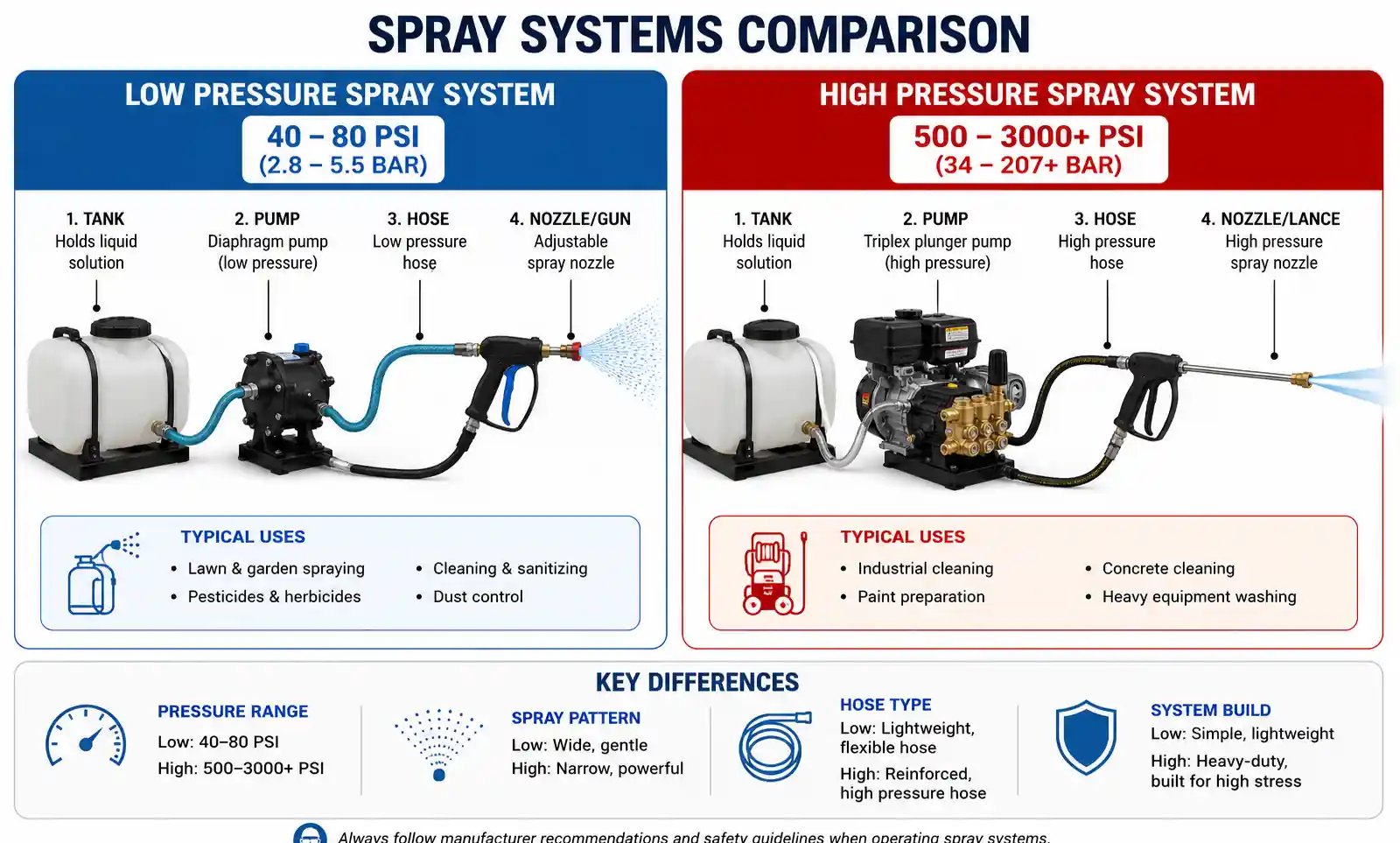
! diagrama de comparación de presión del sistema de pulverización
Rangos de presión definidos:
- Sistemas de baja presión: Normalmente funcionan entre 40 y 80 PSI (libras por pulgada cuadrada)
- Sistemas de alta presión: Generalmente funcionan a 500-3000+ PSI
El nivel de presión afecta directamente al tamaño de las gotas, al patrón de pulverización, al área de cobertura y al tipo de aplicaciones que cada sistema puede manejar eficazmente. Los sistemas de baja presión producen gotas más grandes con mayor cobertura, mientras que los sistemas de alta presión generan niebla fina con una aplicación más concentrada.
Componentes clave: Ambos sistemas comparten componentes básicos como bombas, toberas, mangueras y sistemas de control, pero las especificaciones y los requisitos de durabilidad varían significativamente según la presión de funcionamiento.
2. Sistemas de pulverización a baja presión: visión general y beneficios
Los sistemas de pulverización a baja presión son un caballo de batalla en muchos sectores, ofreciendo fiabilidad y rentabilidad para aplicaciones específicas.
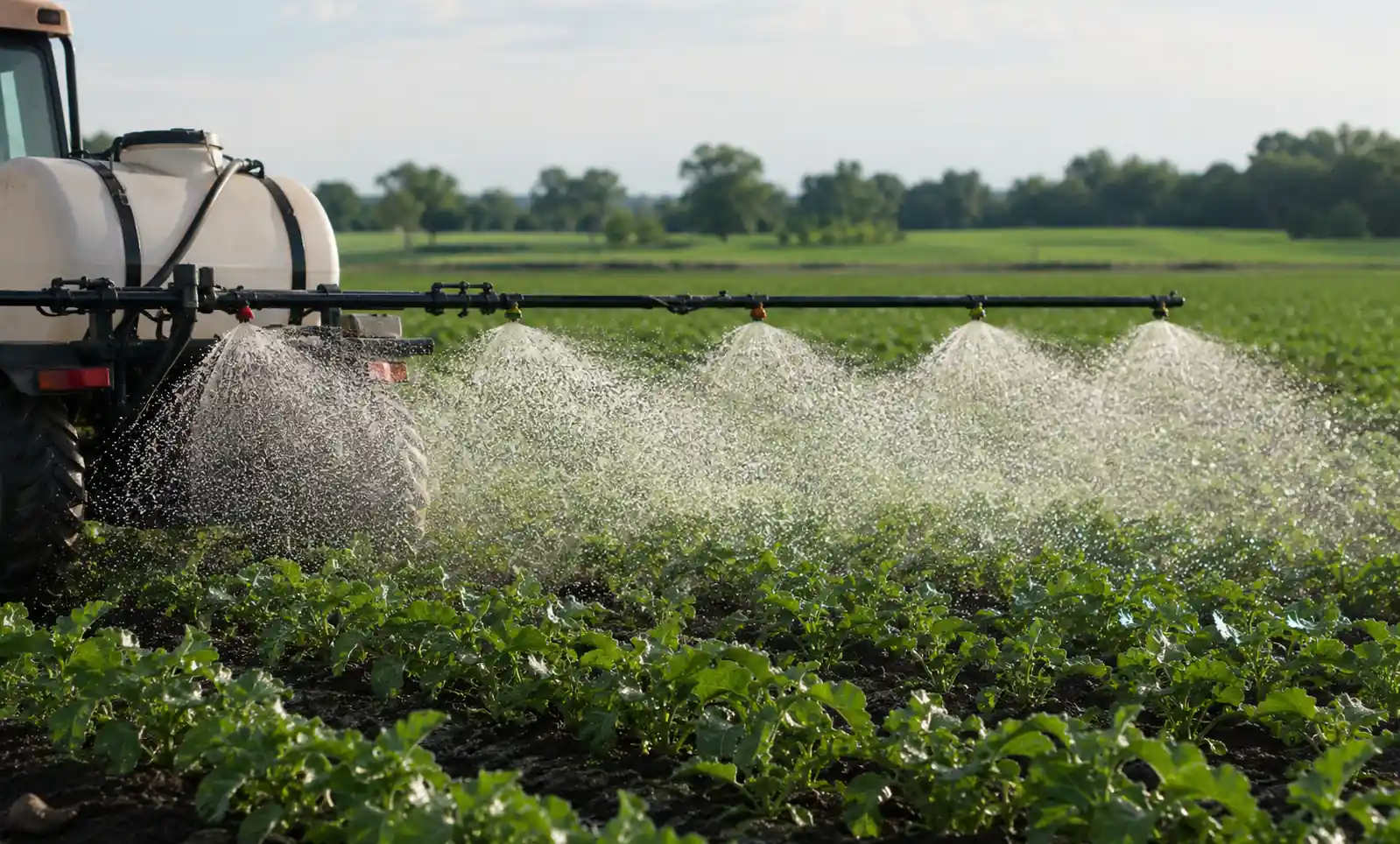
! aplicaciones de sistema de pulverización a baja presión
Ventajas principales:
Inversión inicial rentable: Los sistemas de baja presión suelen costar entre un 30 y un 50% menos que los sistemas de alta presión comparables. Las bombas, mangueras y conexiones no requieren la misma construcción robusta, lo que reduce los gastos iniciales.
Menor consumo energético: Operar a presiones más bajas significa menor demanda de energía. Un sistema típico de baja presión puede consumir entre 1 y 3 CV (caballos de fuerza), en comparación con los 5-15 CV de las alternativas de alta presión.
Mantenimiento simplificado: Menos problemas de desgaste significan una vida útil más larga de los componentes y menor frecuencia de mantenimiento. Los sellos, juntas y componentes de la bomba sufren menos tensión.
Operación más segura: Las presiones operativas más bajas reducen el riesgo de fallo del equipo y lesiones al operador, facilitando la formación y reduciendo potencialmente los costes del seguro.
Aplicaciones ideales:
- Fumigación y riego agrícola
- Supresión del polvo en la construcción y la minería
- Sistemas de refrigeración para ganado
- Limpieza y saneamiento básicos
- Humidificación en invernaderos
- Aplicaciones de control de olores
Limitaciones a tener en cuenta: Los sistemas de baja presión pueden tener dificultades en aplicaciones que requieren atomización fina, penetración profunda o recubrimiento de alta precisión. También son menos eficaces para eliminar contaminantes persistentes o para llegar a zonas difíciles.
3. Sistemas de pulverización a alta presión: visión general y beneficios
Los sistemas de pulverización a alta presión ofrecen un rendimiento superior para aplicaciones exigentes donde la precisión y la potencia son innegociables.
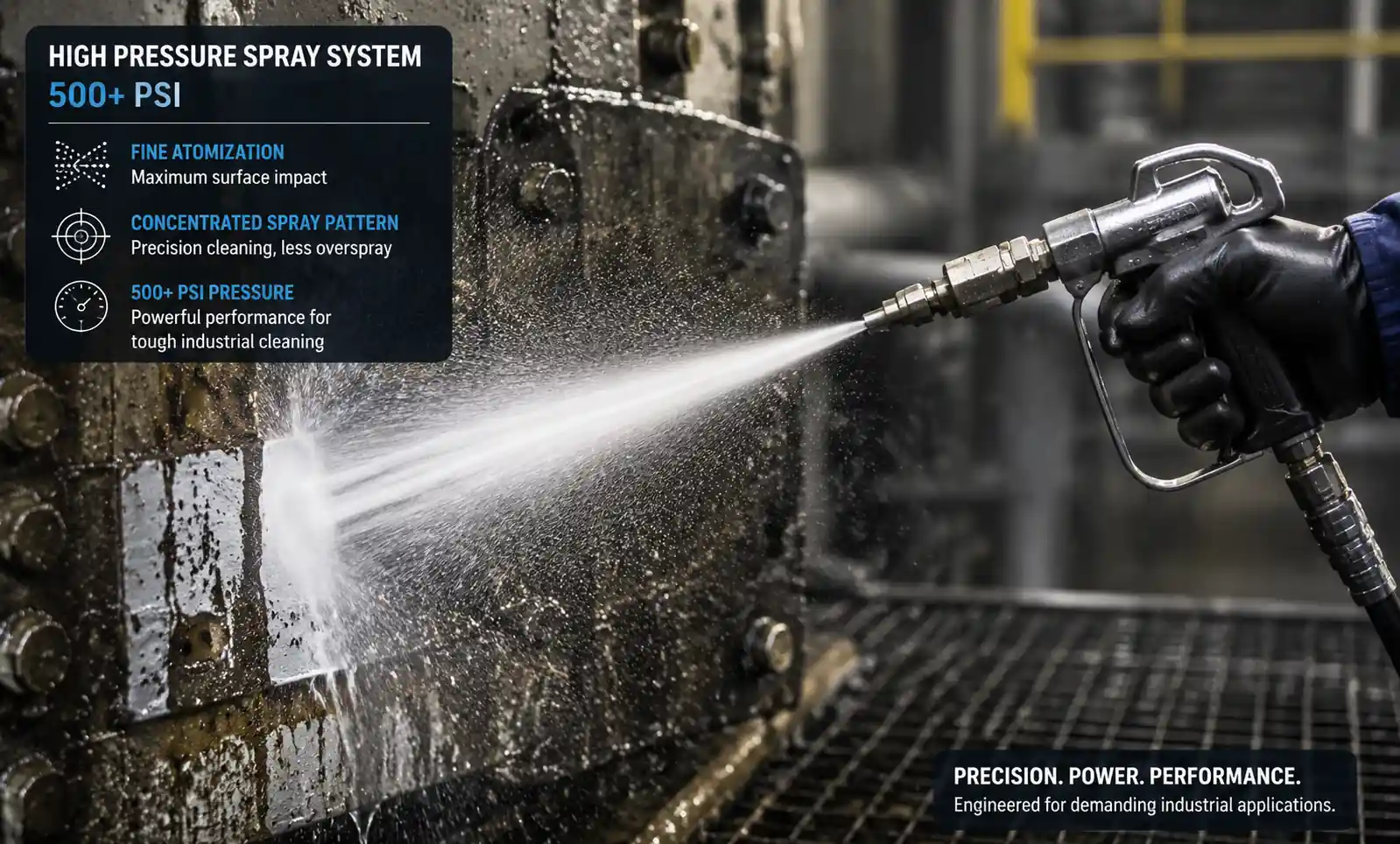
! sistema de pulverización de alta presión-limpieza industrial
Ventajas principales:
Atomización superior: La alta presión crea gotas ultrafinas (10-50 micras), ideales para aplicaciones que requieren cobertura uniforme o máximo contacto superficial.
Aplicación más rápida: Mayor presión significa una cobertura más rápida y menor tiempo de aplicación, lo que puede compensar los mayores costes operativos mediante una mayor productividad.
Versatilidad: Puede manejar una gama más amplia de viscosidades y materiales, desde soluciones finas como agua hasta recubrimientos y productos químicos más gruesos.
Poder de limpieza profunda: Excelente para eliminar contaminantes duros, grasa y acumulación que los sistemas de baja presión no pueden tocar.
Control de Precisión: Más adecuado para aplicaciones que requieren tamaño exacto de gotas y control del patrón de pulverización.
Aplicaciones ideales:
- Limpieza y desengrasado de piezas industriales
- Preparación y recubrimiento superficial
- Sistemas de nebulización y refrigeración de alta gama
- Sanitización en el procesamiento de alimentos
- Detallado automotriz
- Servicios de limpieza a presión
- Agricultura de precisión (alimentación foliar)
Limitaciones a tener en cuenta: Costes iniciales más altos, mayor consumo energético, mantenimiento más frecuente y mayores requisitos de formación para los operadores pueden sobrecargar los presupuestos, especialmente para operaciones más pequeñas.
4. Comparación de costes iniciales de inversión
Comprender la inversión inicial es fundamental para la planificación presupuestaria. Aquí tienes un desglose realista de lo que puedes esperar gastar.
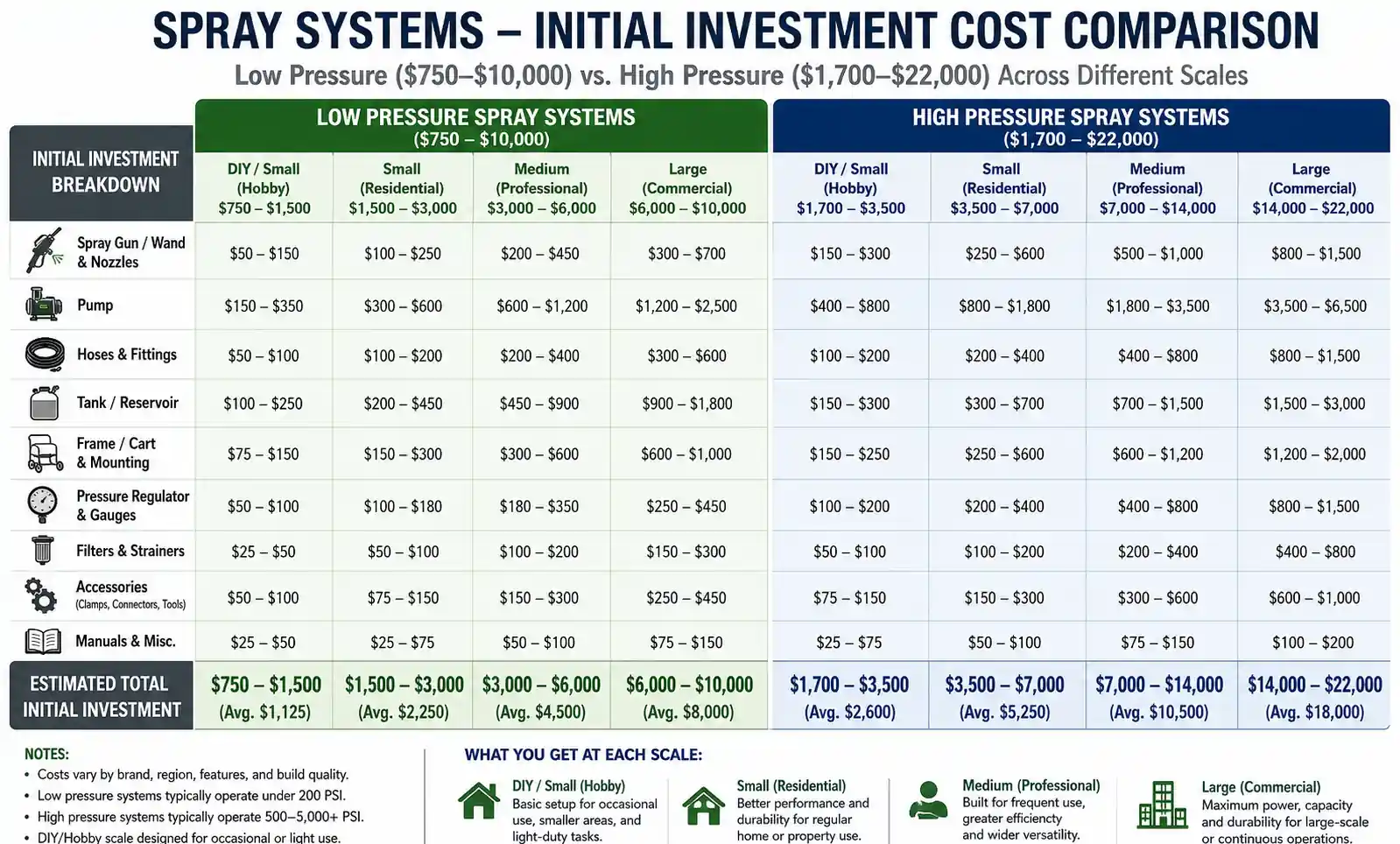
! cuadro comparativo-costes-sistema-spray
Costes del sistema de baja presión:
Configuración básica (a pequeña escala):
- Unidad de bomba: 300-800 dólares
- Boquillas y accesorios: 100-300 dólares
- Mangueras y conexiones: 150-400 dólares
- Sistema de control: 200-500 dólares
- Total: 750-$2,000
Montaje profesional (escala media):
- Sistema de bombeo comercial: 1.500-4.000 dólares
- Matrices de toberas múltiples: 500-1.500 dólares
- Mangueras profesionales: 400-1.000 dólares
- Controles avanzados: 800-2.000 dólares
- Instalación: 500-1.500 dólares
- Total: 3.700-10.000 $
Costes del sistema de alta presión:
Configuración básica (a pequeña escala):
- Bomba de alta presión: 800-2.500 dólares
- Boquillas especializadas: 200-600 dólares
- Mangueras de alta presión: 300-800 dólares
- Sistema de control: 400-1.000 dólares
- Total: 1.700-4.900 $
Montaje profesional (escala media):
- Sistema de bombeo industrial: 3.000-10.000 dólares
- Configuraciones de toberas múltiples: 1.000-3.000 dólares
- Mangueras y accesorios de alta resistencia: 800-2.000 dólares
- Sistemas de control avanzados: 1.500-4.000 dólares
- Instalación profesional: $1,000-$3,000
- Total: 7.300-22.000 $
Resumen de la diferencia de coste: Para operaciones a escala comparable, los sistemas de alta presión suelen costar inicialmente 2-3 veces más que las alternativas de baja presión. Sin embargo, esta brecha se reduce al tener en cuenta las ganancias de productividad y los requisitos específicos de la aplicación.
5. Costes operativos y eficiencia energética
La inversión inicial es solo el principio. Los costes operativos a lo largo de la vida útil del sistema suelen superar el precio de compra.
Comparación de consumo energético:
Sistemas de baja presión:
- Consumo medio de potencia: 1-3 CV (0,75-2,25 kW)
- Uso típico: 4-8 horas diarias
- Coste mensual de energía (a 0,12 $/kWh): 22-65 $
- Coste anual de energía: 260-780 dólares
Sistemas de alta presión:
- Consumo medio: 5-15 CV (3,75-11,25 kW)
- Uso típico: 4-8 horas diarias
- Coste mensual de energía (a 0,12 $/kWh): 110 - 325 $
- Coste energético anual: 1.300-3.900 dólares
Consumo de agua: Curiosamente, los sistemas de alta presión suelen consumir menos agua debido a una atomización más fina y una cobertura más eficiente. Un sistema de baja presión puede usar entre 2 y 5 galones por minuto (GPM), mientras que un sistema de alta presión alcanza una cobertura similar a 0,5-2 GPM.
Costes químicos y de materiales: La superior atomización de los sistemas de alta presión puede reducir el uso de productos químicos entre un 20 y un 40% en muchas aplicaciones, ya que una mejor distribución de gotas significa menos residuos y una cobertura más eficaz.
Ejemplo de cálculo de ROI: Para una instalación que funciona 2.000 horas anuales:
- Baja presión: 520 $ de energía + 2.400 $ agua/productos químicos = $2.920/año
- Alta presión: 2.600 $ de energía + 1.400 $ agua/productos químicos = 4.000 $/año
La diferencia anual de 1.080 dólares podría justificar una baja presión para operaciones presupuestarias, pero las ganancias de productividad podrían cambiar la ecuación.
6. Requisitos de mantenimiento y gastos a largo plazo
Los costes de mantenimiento pueden hacer que tu presupuesto sea decisivo o deshecho a lo largo de la vida útil de un sistema, que dura entre 5 y 10 años.
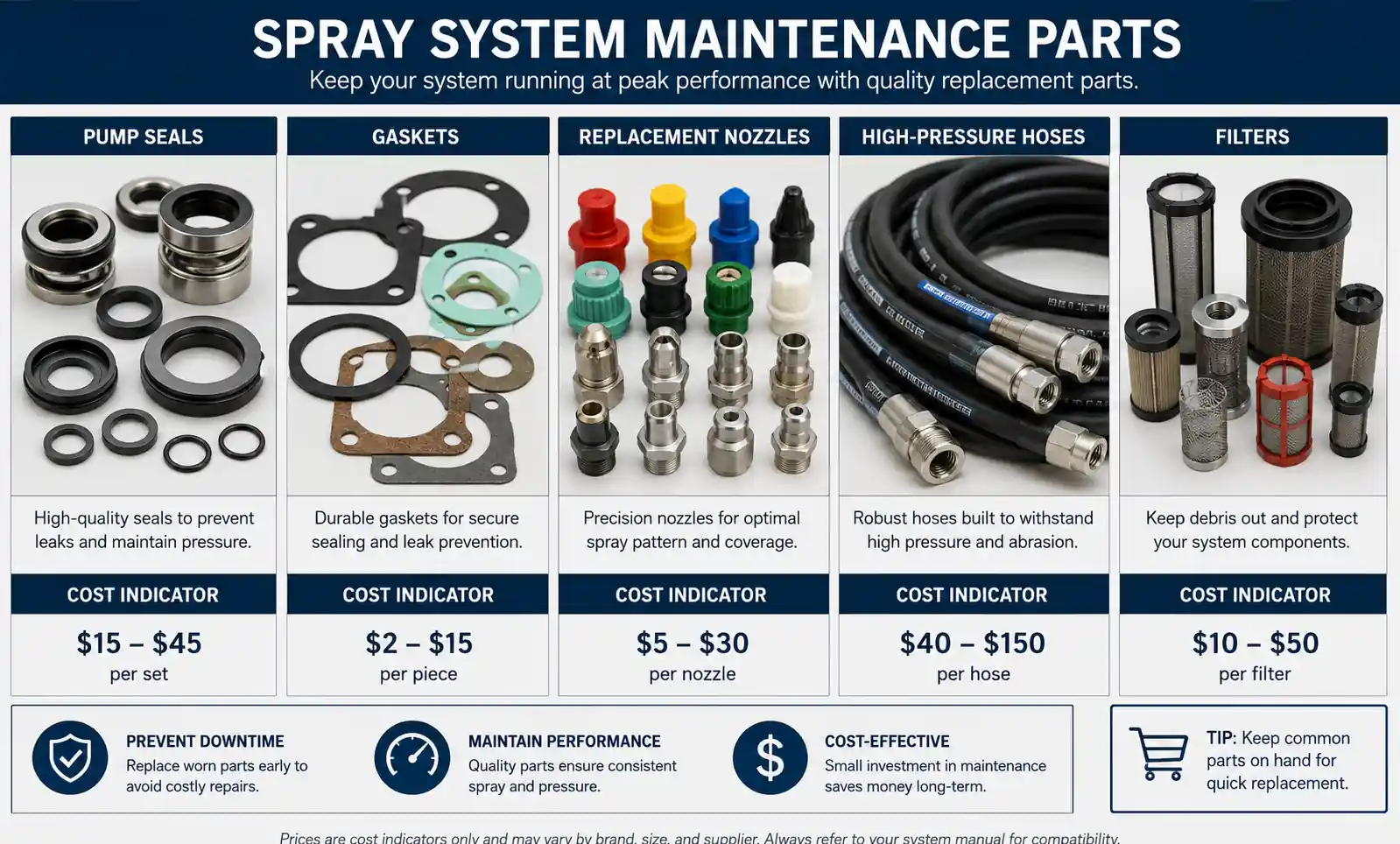
! sistema de pulverización-mantenimiento-componentes
Mantenimiento del sistema de baja presión:
Costes anuales de mantenimiento:
- Juntas y juntas de bomba: 50-150 $
- Reemplazo de tobera: 30-100 $
- Sustitución de manguera: 50-150 $
- Cambios de filtro: 40-80 $
- Servicio profesional (opcional): 200-400 $
- Total: 170-480 $ (DIY) o 370-880 $ (con servicio)
Vida útil de los componentes:
- Bomba: 5-8 años
- Boquillas: 2-4 años
- Mangueras: 3-5 años
Mantenimiento del sistema de alta presión:
Costes anuales de mantenimiento:
- Juntas de bomba de alta presión: 150-400 dólares
- Reemplazo especializado de toberas: 100-300 dólares
- Sustitución de manguera de alta presión: 150-400 $
- Mantenimiento de filtros y válvulas: 80-150 dólares
- Servicio profesional (recomendado): 400-800 $
- Total: 480-1.250 $ (DIY) o 880-2.050 $ (con servicio)
Vida útil de los componentes:
- Bomba: 3-6 años
- Boquillas: 1-3 años
- Mangueras: 2-4 años
Coste total de propiedad a 10 años:
Sistema de baja presión:
- Inversión inicial: 5.000 $
- Energía (10 años): 5.200 $
- Mantenimiento: 3.700-8.800 dólares
- Reemplazo de componentes principales: 2.000-3.000 dólares
- Total: 15.900-21.000 $
Sistema de alta presión:
- Inversión inicial: 12.000 dólares
- Energía (10 años): 26.000 dólares
- Mantenimiento: 8.800-20.500 dólares
- Reemplazo de componentes principales: 4.000-6.000 dólares
- Total: 50.800-64.500 $
La diferencia significativa en los costes a largo plazo hace que los sistemas de baja presión sean atractivos para operaciones con presupuesto limitado, pero recuerda tener en cuenta la productividad y la efectividad de la aplicación.
7. Consideraciones específicas de la aplicación
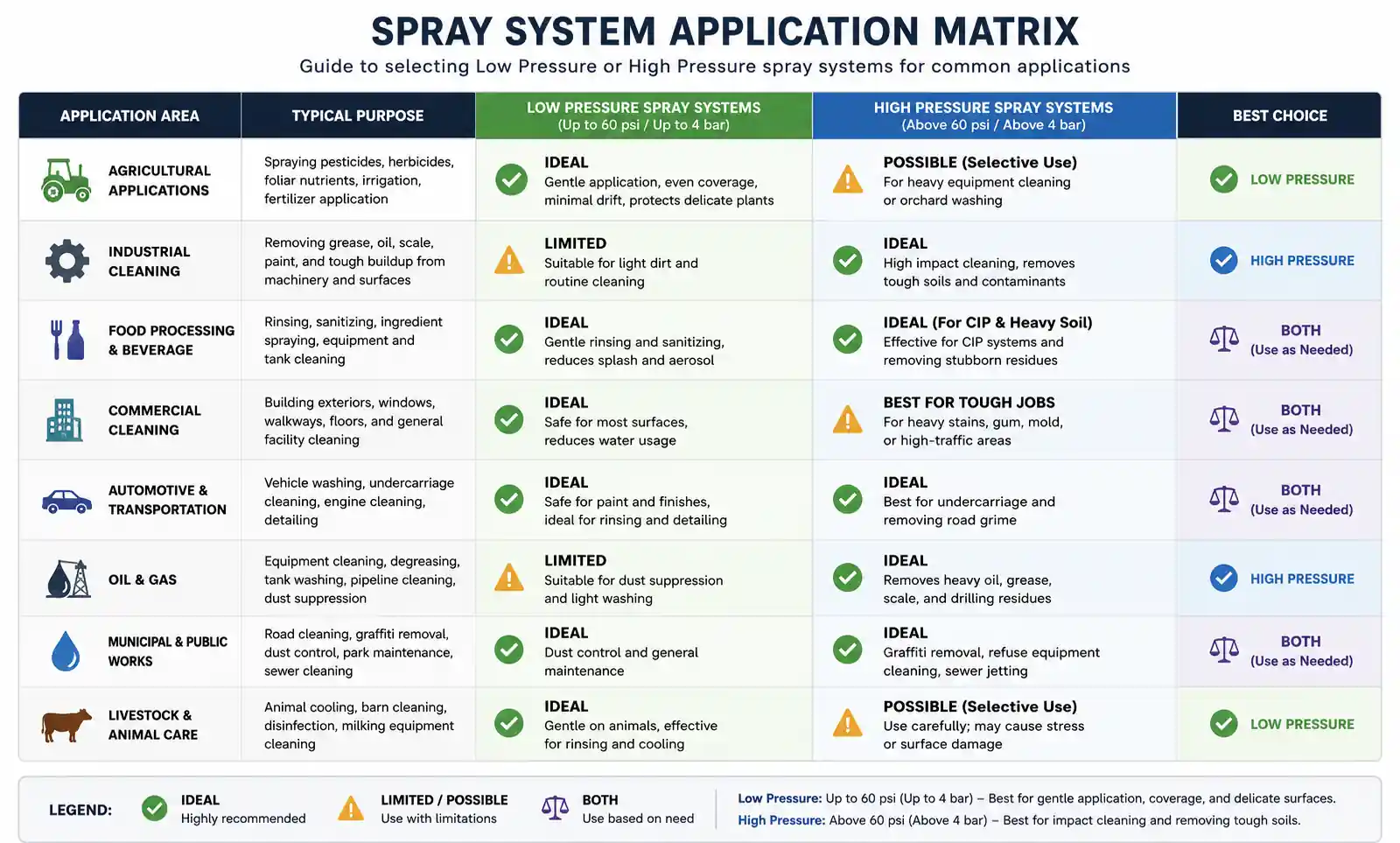
El sistema "mejor" depende totalmente de tu caso de uso específico. Así es como se puede ajustar el tipo de sistema a la aplicación.
! matriz de aplicación del sistema de pulverización
Cuando la baja presión es la opción económica más inteligente:
-
Aplicaciones agrícolas: Para fumigación general de cultivos, riego y refrigeración de ganado, la baja presión ofrece un rendimiento adecuado a una fracción del coste.
-
Control del Polvo: Las obras, las operaciones mineras y los eventos al aire libre se benefician de la amplia cobertura de baja presión y menores costes operativos.
-
Desinfección básica: Servicios de comida, escuelas y limpieza industrial ligera donde no es necesario hacer limpieza profunda.
-
Operaciones de invernadero: La humidificación y el control básico de plagas funcionan bien con sistemas de baja presión.
-
Startups con presupuesto limitado: Cuando el capital es limitado y las solicitudes no exigen un rendimiento de alta presión.
Cuando la alta presión justifica la inversión:
-
Limpieza industrial: Las instalaciones de fabricación que requieren la eliminación de grasa, aceite y contaminantes persistentes requieren energía a alta presión.
-
Preparación de la superficie: Antes de pintar, recubrir o unir, la alta presión garantiza una preparación adecuada de la superficie.
-
Procesamiento de alimentos: Cuando los estándares de desinfección exigen una cobertura y penetración exhaustivas, a menudo se requiere alta presión.
-
Agricultura de precisión: La alimentación foliar y la aplicación dirigida de pesticidas se benefician de la atomización fina.
-
Servicios profesionales: Los servicios de limpieza a presión, detallado y limpieza necesitan alta presión para ofrecer resultados que los clientes esperan.
-
Aplicaciones de alto valor: Cuando la calidad, el acabado o la limpieza del producto afectan directamente a los ingresos, la alta presión merece la pena la inversión.
Enfoque híbrido: Algunas operaciones se benefician de contar con ambos sistemas: baja presión para tareas rutinarias y alta presión para aplicaciones especializadas. Esto maximiza la eficiencia presupuestaria manteniendo la capacidad.
8. Marco de Decisiones Económicos
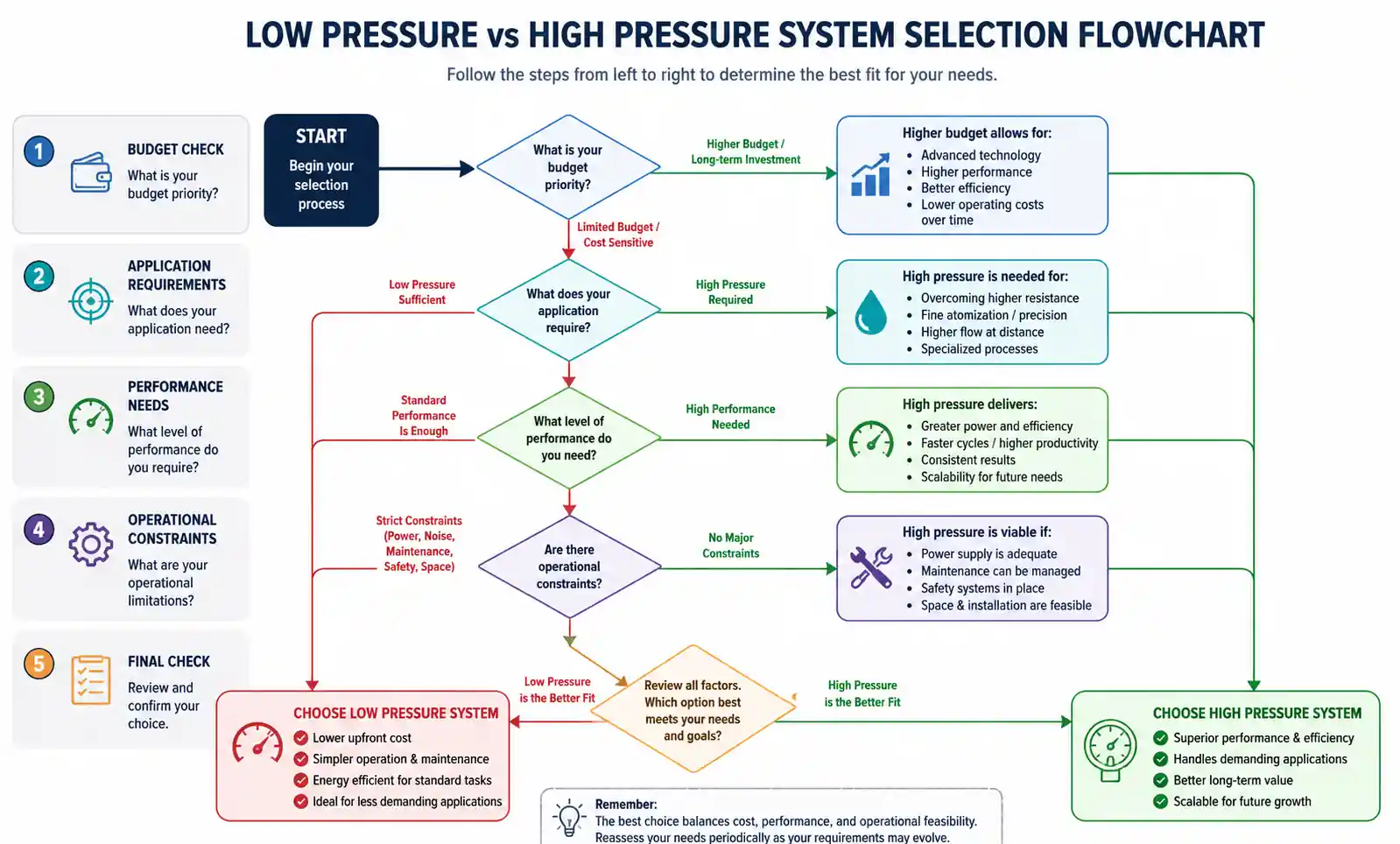
Utiliza este marco para determinar qué sistema se adapta a tu presupuesto y necesidades.
! sistema de pulverización-diagrama de decisión-flujo
Paso 1: Define tus requisitos
- ¿Qué estás rociando? (agua, productos químicos, recubrimientos)
- ¿Qué superficie o área? (cultivos, equipos, edificios)
- ¿Cuál es el resultado deseado? (limpieza, recubrimiento, enfriamiento)
- ¿Qué estándares de calidad debes cumplir?
Paso 2: Calcula tu presupuesto
- Capital disponible para inversión inicial
- Presupuesto operativo mensual
- Asignación anual de mantenimiento
- Vida útil esperada del sistema
Paso 3: Evalúa tus limitaciones
- Disponibilidad y costes de energía
- Suministro de agua y costes
- Nivel de habilidad del operador
- Requisitos de espacio e instalación
Paso 4: Proyecta tu retorno de la inversión
- Ganancias de productividad por una aplicación más rápida
- Ahorro de costes laborales
- Mejoras en la eficiencia de materiales
- Mejoras de calidad y reducción de reestructuración
Paso 5: Considerar la escalabilidad
- ¿Crecerán tus necesidades?
- ¿Se puede ampliar el sistema?
- ¿Hay equipo de segunda mano disponible?
- ¿Cuál es el valor de reventa?
Matriz de Decisiones:
Elige Baja Presión si:
- ✓ El presupuesto inicial es inferior a 5.000 dólares
- ✓ Los costes energéticos son una preocupación importante
- ✓ Las aplicaciones no requieren atomización fina
- ✓ El mantenimiento debe ser sencillo y adaptado al bricolaje
- ✓ La cobertura amplia es más importante que la precisión
Elige Alta Presión si:
- ✓ El presupuesto permite $10,000+ inversión inicial
- ✓ La aplicación requiere gotas finas o limpieza profunda
- ✓ La productividad y la velocidad justifican mayores costes operativos
- ✓ Los estándares de calidad requieren un rendimiento superior
- ✓ Mantenimiento profesional accesible
Consejos para optimizar el presupuesto:
-
Compra de segunda mano estratégicamente: Equipos usados de alta calidad pueden reducir los costes iniciales entre un 40 y un 60%. Céntrate en marcas de confianza con piezas disponibles.
-
Empieza con poco a poco, crece: Empieza con un sistema básico y amplía según el presupuesto lo permita y las necesidades crezcan.
-
Opciones de arrendamiento: Para sistemas de alta presión, el arrendamiento puede repartir costes e incluir mantenimiento.
-
Eficiencia energética: Invierte en variadores de frecuencia (VFD) para reducir el consumo energético en un 20-30%.
-
Mantenimiento preventivo: El mantenimiento regular evita fallos costosos y prolonga la vida útil de los componentes.
9. Errores comunes a evitar
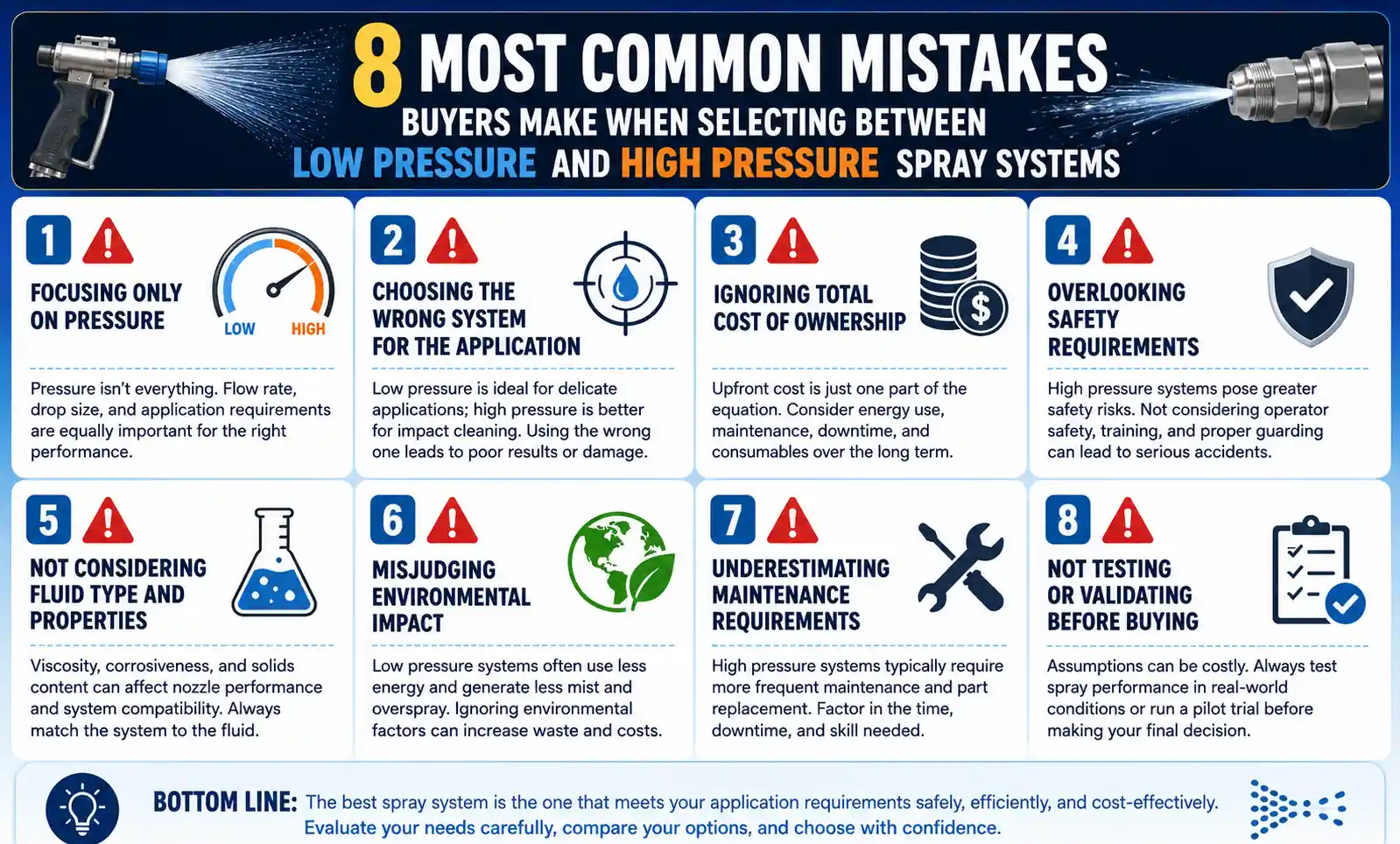
Aprende de los errores costosos de otros al elegir entre sistemas de baja y alta presión.
! sistema de pulverización-infografía de errores comunes
Error #1: Elegir solo por el precio La opción más barata al principio suele costar más a largo plazo. Un sistema de baja presión de 1.000 dólares que no puede hacer bien el trabajo costará más en tiempo desperdiciado, materiales y reemplazo eventual que un sistema de alta presión de 3.000 dólares que funcione correctamente.
Error #2: Capacidad de sobrecompra No compres un sistema de 3000 PSI cuando 1000 PSI bastarían. Pagarás más al principio y desperdiciarás energía operando a mitad de capacidad. Ajusta la presión a los requisitos reales.
Error #3: Subestimar los costes operativos Muchos compradores se centran en el precio de compra e ignoran los costes de energía, agua y mantenimiento que se acumulan a lo largo de los años. Calcula el coste total de propiedad, no solo la inversión inicial.
Error #4: Ignorar los requisitos de solicitud Usar baja presión para aplicaciones que requieren alta presión (o viceversa) conduce a malos resultados, desperdicio de materiales y frustración de los operadores. Adapta las capacidades del sistema a las necesidades reales.
Error #5: Saltarse la instalación profesional La instalación por tu cuenta puede ahorrar entre 500 y 1.500 dólares inicialmente, pero una configuración inadecuada causa ineficiencia, desgaste prematuro y riesgos para la seguridad que cuestan mucho más de reparar.
Error #6: Descuidar el mantenimiento Saltarse el mantenimiento rutinario para ahorrar dinero sale mal cuando las bombas fallan prematuramente o el rendimiento se deteriora. Presupuesto para el servicio regular desde el primer día.
Error #7: Comprar componentes incompatibles Mezclar boquillas de baja calidad con bombas de alta calidad, o viceversa, crea desequilibrios del sistema que reducen el rendimiento y aumentan el desgaste.
Error #8: Olvidarse del entrenamiento Los operadores que no entienden el sistema adecuado usan materiales de desecho, dañan equipos y crean riesgos para la seguridad. Presupuesta para la formación.
10. Preguntas frecuentes
P: ¿Puedo convertir un sistema de baja presión a alta presión más adelante? R: Generalmente no. La bomba, las mangueras, los accesorios y las boquillas son fundamentalmente diferentes. Básicamente estarías comprando un sistema nuevo. Planifica tus necesidades a largo plazo desde el principio.
P: ¿Cuánto puedo ahorrar en energía con un sistema de baja presión? R: Normalmente entre un 60 y un 75% en comparación con sistemas de alta presión de escala similar. Para operaciones que funcionan entre 2.000+ horas anuales, esto se traduce en un ahorro anual de 1.500 a 3.000 dólares.
P: ¿Los sistemas de alta presión siempre son mejores para limpiar? R: No siempre. Para superficies delicadas, electrónica o materiales blandos, la alta presión puede causar daños. A baja presión con los productos químicos adecuados suele funcionar mejor y de forma más segura.
P: ¿Cuál es el presupuesto mínimo para un sistema fiable? R: Para baja presión: entre 1.500 y 2.500 dólares te dan un equipo básico de calidad. Para alta presión: mínimo de 3.000 a 5.000 dólares para un rendimiento fiable. Cualquier cosa más barata probablemente decepcionará.
P: ¿Cuánto suelen durar estos sistemas? R: Con el mantenimiento adecuado, los sistemas de baja presión duran entre 8 y 12 años, los de alta presión entre 6 y 10 años. Las bombas suelen ser el primer componente importante que necesita ser reemplazado.
P: ¿Puedo usar las mismas boquillas para ambos sistemas? R: No. Las boquillas son específicas para la presión. El uso de boquillas de baja presión en sistemas de alta presión (o viceversa) causa un bajo rendimiento y posibles riesgos para la seguridad.
P: ¿Y los requisitos de calidad del agua? R: Los sistemas de alta presión son más sensibles a la calidad del agua. El agua dura, los sedimentos y los contaminantes provocan un desgaste más rápido. Presupuesta para la filtración si la calidad del agua es mala.
P: ¿Es realmente necesario un mantenimiento profesional? R: Para sistemas de baja presión, el mantenimiento DIY suele ser suficiente con habilidades mecánicas básicas. Los sistemas de alta presión se benefician significativamente del servicio profesional anual para mantener el rendimiento y la seguridad.
P: ¿Cómo calculo el retorno del retorno para mi situación específica? R: Haz un seguimiento de estas métricas: tiempo ahorrado por aplicación, reducción del consumo de materiales, cambios en el coste laboral, mejoras de calidad y costes de mantenimiento. Compáralo con la diferencia de coste entre sistemas durante 5 años.
P: ¿Cuál es la mejor manera de financiar un sistema de alta presión con un presupuesto ajustado? R: Considera el alquiler de equipos (que distribuye los costes entre 3 y 5 años), equipos usados de distribuidores de confianza, o empezar con un sistema más pequeño y ampliarlo. Algunos proveedores ofrecen planes de pago.
Conclusión: Tomando una decisión inteligente para el presupuesto
Elegir entre sistemas de pulverización de baja y alta presión no consiste en encontrar la "mejor" opción, sino en encontrar la que se adapte a tu presupuesto, aplicaciones y requisitos operativos específicos.
Los sistemas de baja presión destacan cuando las limitaciones presupuestarias son ajustadas, las aplicaciones no exigen atomización fina y la eficiencia energética es fundamental. Son la opción inteligente para operaciones agrícolas, limpieza básica, control del polvo y situaciones donde la cobertura amplia importa más que la precisión.
Los sistemas de alta presión justifican sus mayores costes cuando la calidad de la aplicación afecta directamente a tus resultados, las ganancias de productividad compensan los gastos operativos o los estándares del sector exigen un rendimiento superior. Son esenciales para la limpieza industrial, la preparación de superficies, la agricultura de precisión y los servicios profesionales.
La clave para una decisión económica es una evaluación honesta de tus necesidades reales, un cálculo realista de los costes totales de propiedad y la adaptación de las capacidades del sistema a los requisitos de la aplicación. No dejes que el shock inicial te lleve a un equipo inadecuado, pero igualmente, no gastes en exceso en capacidades que nunca vas a usar.